GTBUY Shipping Guide: Parcel Weight, Packaging, Routes and Cost-Saving Tips
Understand GTBUY shipping costs, parcel weight, packaging, consolidation, shipping routes, customs and practical ways to reduce international delivery expenses.
GoGo Finder
7/16/20269 min read
International shipping is often the most confusing part of using a shopping agent.
A product may look inexpensive on Weidian, Taobao, or 1688, but the final cost can change significantly once domestic delivery, warehouse handling, parcel weight, packaging, and international shipping are included.
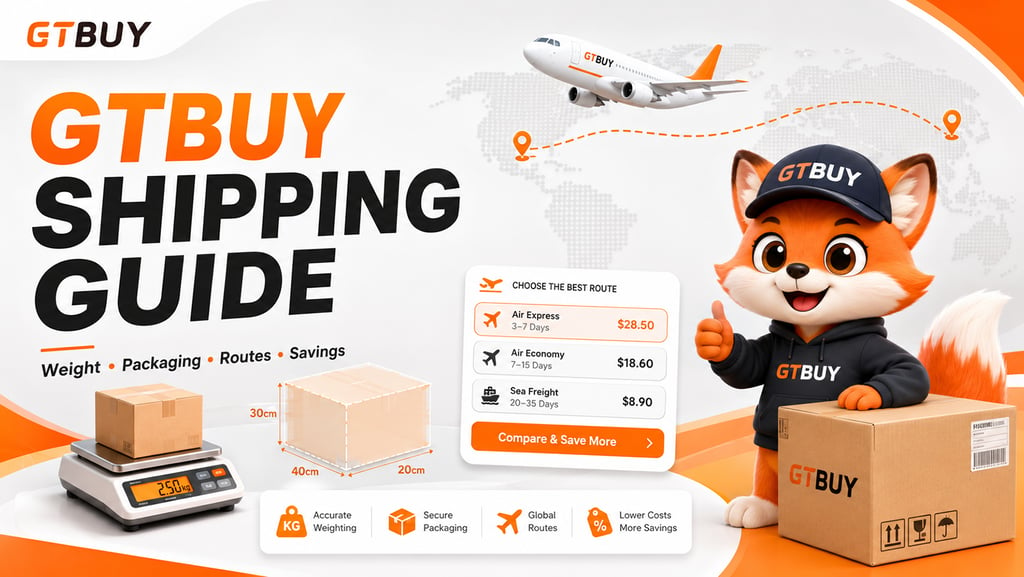
GTBUY separates the shopping process into two stages. First, the product is purchased and delivered to the GTBUY warehouse. After it arrives and passes your QC review, you create an international parcel, enter the destination details, choose an available shipping route, and pay the shipping charge. GTBUY’s official beginner guide follows this general parcel-submission workflow, while its estimation page allows users to enter a destination and parcel weight to view eligible routes.
This guide explains the process clearly and shows how to avoid unnecessary shipping costs without compromising parcel protection.
Quick Answer: How Does GTBUY Shipping Work?
The typical GTBUY shipping process is:
Purchase products from a supported Chinese marketplace.
Wait for each item to arrive at the GTBUY warehouse.
Review the warehouse QC photos.
Return or exchange unsuitable products before shipping.
Select the warehouse items you want to combine.
Choose packaging or value-added services where available.
Enter your international address.
Compare the available shipping routes.
Pay the international shipping charge.
Track the parcel after dispatch.
GTBUY’s official guide instructs users to submit a parcel, fill in delivery details, choose a recommended shipping route, and later track the shipment from the parcel-details area.
1. Product Cost and Shipping Cost Are Separate
When you order through GTBUY, the first payment generally covers:
The marketplace product price
Domestic delivery from the seller to the GTBUY warehouse
Any applicable purchasing charges shown during checkout
International shipping is usually paid later, after the item reaches the warehouse and its actual weight and dimensions are available.
This distinction matters because the product page price is not the complete delivered cost.
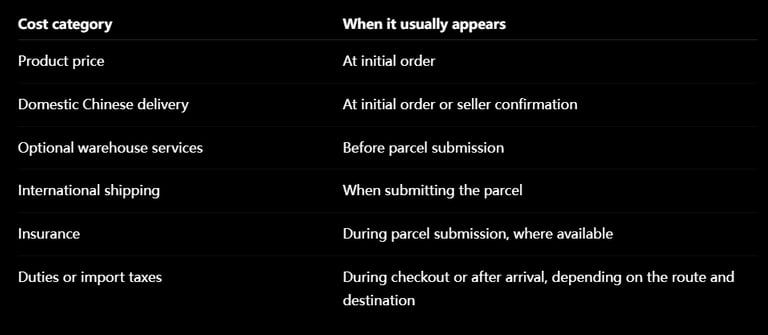
Your final expenditure may include:
Always estimate the landed cost, not only the product price.
2. Wait Until Warehouse Data Is Available
Marketplace listings do not always provide reliable shipping weight or dimensions.
After an item reaches the GTBUY warehouse, the warehouse record may provide more useful information, including:
Actual item weight
Package dimensions
QC photos
Product quantity
Storage status
Available parcel options
GTBUY product pages display fields for estimated weight and estimated dimensions, while also promoting warehouse inspection and up to 90 days of free storage. Actual availability and current storage terms should still be verified inside the user account before relying on them.
Submitting a parcel after all selected items have arrived gives you a more accurate basis for comparing routes and packaging choices.
3. Actual Weight Versus Volumetric Weight
International carriers may charge based on either:
Actual weight: the physical weight measured on a scale
Volumetric weight: a calculated weight based on parcel dimensions
Volumetric weight matters because a large lightweight box still occupies substantial aircraft or vehicle space.
A common logistics formula is:
Length × Width × Height ÷ carrier divisor
The exact divisor varies by shipping line. The carrier may bill whichever is greater: actual weight or volumetric weight.
Example
Suppose a parcel measures:
50 × 40 × 30 cm
Using a divisor of 6,000:
50 × 40 × 30 ÷ 6,000 = 10 kg
Even when the parcel physically weighs only 7 kg, that particular carrier could bill it as 10 kg.
This is why shoe boxes, rigid gift boxes, large bags, and oversized packaging can materially increase shipping costs.
4. Why the First Shipping Estimate May Change
A shipping calculator is useful, but it is still an estimate.
The final charge can differ because of:
Actual warehouse weight
Final packaging materials
Parcel dimensions
Volumetric-weight rules
Restricted-product classification
Remote-area charges
Route availability
Currency conversion
Carrier price changes
GTBUY’s shipping-estimation page asks for the destination and parcel weight before returning eligible routes, which is useful for early planning. However, the final warehouse parcel data is generally more relevant than a pre-purchase estimate.
Treat an estimator as a planning tool rather than a guaranteed quotation.
5. Combine Items Through Parcel Consolidation
One of the main reasons to use an agent warehouse is the ability to combine products from different sellers into one international parcel.
Consolidation can help by:
Reducing repeated minimum shipping charges
Combining several domestic orders
Allowing one international tracking number
Making better use of package space
Simplifying delivery management
However, combining everything is not always the cheapest or safest option.
Consider separate parcels when:
One item is unusually heavy
One item contains batteries or liquids
Fragile goods require different protection
A restricted item removes access to cheaper routes
The combined parcel becomes too large
Customs risk increases with parcel value or quantity
The best parcel is not necessarily the largest possible parcel. It is the parcel that balances cost, available routes, protection, and customs practicality.
6. Remove Unnecessary Packaging Carefully
Packaging removal is one of the most common ways to reduce volumetric weight.
Potentially removable materials include:
Seller shipping cartons
Excess plastic bags
Decorative gift boxes
Shoe boxes
Unnecessary paper filling
Duplicate outer packaging
However, packaging should not be removed automatically.
Keep stronger protection when shipping:
Fragile goods
Electronics
Structured bags
Collectible packaging
Products intended for resale
Items that can deform under pressure
Shoes requiring shape protection
Practical approach
Remove packaging when it is bulky but provides little protection. Keep it when it prevents damage, compression, moisture, or shape loss.
Saving a small amount on freight is not worthwhile when the product reaches you damaged.
7. Consider Rehearsal or Pre-Packaging Services
Where available, a rehearsal or pre-packaging service can improve shipping accuracy.
The warehouse may:
Pack the selected items
Remove requested packaging
Measure the final box
Record the final actual weight
Record final dimensions
Recalculate eligible routes
This is especially useful for:
Large hauls
Multiple shoe boxes
Bulky clothing
Bags with rigid packaging
Parcels close to a shipping-line limit
Buyers choosing between actual-weight and volumetric routes
Check the current GTBUY warehouse interface for available service names, pricing, and limitations, as these may change.
8. Compare Shipping Routes Properly
The cheapest route is not always the best choice.
When comparing GTBUY shipping options, review:
Price
Estimated delivery window
Tracking availability
Weight limits
Size limits
Product restrictions
Insurance or compensation terms
Customs or tax handling
Destination coverage
Actual-weight versus volumetric billing
Economy routes
Usually suitable for:
Lower-value parcels
Non-urgent orders
Flexible buyers
Clothing and basic accessories
Potential disadvantages:
Longer transit times
Fewer tracking updates
Lower compensation limits
More variable delivery performance
Standard tracked routes
Often provide a better balance of:
Price
Tracking
Delivery time
Route availability
Express routes
Potentially useful for:
Urgent parcels
High-value orders
Buyers prioritizing speed
Potential disadvantages:
Higher cost
More formal customs processing
Stricter dimension or product rules
Route availability can vary according to destination, parcel characteristics, and current carrier policy.
9. Understand Restricted and Sensitive Products
Some products cannot use every shipping route.
Common restricted or sensitive categories may include:
Batteries
Electronics
Liquids
Fragrances
Cosmetics
Food
Powders
Magnets
Sharp objects
Oversized goods
Products with pressurized containers
A restricted item can affect the entire consolidated parcel.
For example, adding a small battery-powered accessory may remove several low-cost shipping routes that would otherwise accept your clothing and shoes.
Before ordering a sensitive product:
Check whether GTBUY can purchase it.
Check whether it can enter the warehouse.
Check which routes accept it.
Estimate the restricted-line cost.
Decide whether separate shipping is more efficient.
A cheap restricted product may become expensive once its limited shipping options are considered.
10. Review Insurance and Compensation Terms
Insurance may be worth considering for a higher-value parcel, but users should understand exactly what the coverage includes.
Check:
Maximum compensation
Whether loss and damage are both covered
Excluded product categories
Documentation requirements
Claim deadlines
Whether shipping fees are covered
Whether customs seizure is excluded
Whether partial damage qualifies
Do not assume that the word “insurance” means every possible outcome is covered.
Keep:
Order records
QC photos
Parcel photos
Shipping receipts
Tracking screenshots
Unboxing evidence for damaged parcels
These records may be useful if a claim becomes necessary.
11. Customs, Declarations, Taxes and Duties
GTBUY can submit the parcel to a carrier, but customs authorities control import clearance.
Possible outcomes include:
Normal clearance
Request for payment of duties or taxes
Request for an invoice
Physical inspection
Delay
Return to sender
Seizure when goods violate local rules
Import treatment depends on:
Destination country
Declared value
Product type
Parcel quantity
Local tax thresholds
Brand or intellectual-property rules
Personal-use standards
Current customs enforcement
Use accurate and reasonable parcel information. Asking for deliberately false declarations can expose the parcel and the buyer to additional risk.
For high-value or regulated goods, review the destination country’s current import rules before ordering.
12. Check the Address Before Payment
Address mistakes can be costly.
Before submitting the parcel, confirm:
Full recipient name
Street and house number
Apartment or unit number
City
State or province
Postal code
Country
Telephone number
Email address, where requested
Use Latin characters when required by the destination carrier.
Also check whether:
The carrier delivers to PO boxes
The phone number includes the country code
The postal code matches the city
The recipient name matches any customs requirements
The address is not copied with missing lines
Once the parcel has been dispatched, correction may be difficult or impossible.
13. Track the Parcel With Realistic Expectations
GTBUY’s beginner guide directs users to track dispatched shipments from the parcel-details section.
Tracking may pass through stages such as:
Parcel submitted
Warehouse packing
Carrier collected
Export processing
Airline or line-haul transit
Destination customs
Local carrier handover
Delivery
A lack of updates for several days does not always mean the parcel is lost. Tracking gaps can occur:
Before export scanning
During airline transit
During customs inspection
Between international and local carriers
During public holidays
Contact support when the parcel exceeds the route’s expected range or when tracking shows a clear exception.
14. Practical Ways to Reduce GTBUY Shipping Cost
Consolidate compatible products
Combine items when they can use the same route and packaging method.
Avoid bulky low-value goods
Large inexpensive products can have poor value after volumetric shipping.
Remove unnecessary boxes
Shoe and gift boxes can substantially increase parcel dimensions.
Compare several routes
Do not choose only by the first displayed option.
Check sensitive-product restrictions
One restricted item can raise the cost of the whole parcel.
Use measurements before purchasing
Avoid paying domestic and return shipping for unsuitable items.
Review QC promptly
Return incorrect products before the international parcel is created.
Plan a balanced haul
Very small parcels can be inefficient because of minimum charges, while oversized parcels can trigger higher rates or fewer available routes.
Use estimated weight before ordering
GTBUY product pages may display estimated-weight and dimension fields, while the estimation tool helps users explore available routes by destination and weight.
15. When Should You Ship Your Warehouse Items?
Submit the parcel when:
All intended products have arrived
Every item has passed QC review
Return or exchange issues are resolved
Storage time remains sufficient
Current routes are acceptable
You understand the estimated cost
The parcel does not contain an avoidable restricted item
Your delivery address is confirmed
Do not rush international shipment simply because the first item has arrived.
At the same time, do not ignore warehouse items indefinitely. GTBUY currently advertises up to 90 days of free storage on several product pages, but buyers should verify the current account policy and any fees before reaching the limit.
GTBUY Parcel Submission Checklist
Before paying for international shipping, confirm:
Every selected item has arrived
QC photos have been reviewed
Wrong or defective items were resolved
Product restrictions were checked
Unnecessary packaging was considered
Fragile items have enough protection
Final weight and dimensions are reasonable
Multiple routes were compared
Insurance terms were reviewed
Customs risks were considered
Recipient name and address are correct
Telephone number includes the country code
The final cost still makes sense
Frequently Asked Questions
How much does GTBUY shipping cost?
GTBUY shipping cost depends on destination, actual or volumetric weight, parcel dimensions, product restrictions, packaging and the selected route. Use the official estimation tool for initial planning, then rely on final warehouse parcel data before payment.
Does GTBUY combine products from different sellers?
The shopping-agent warehouse model allows buyers to receive products from different sellers and select them for parcel submission. Consolidation can reduce repeated international shipping charges, although restricted or fragile goods may be better sent separately.
Does GTBUY offer free warehouse storage?
Several current GTBUY product pages advertise 90 days of free storage. Because storage terms may change, confirm the policy and any overdue fees in your account before relying on the full period.
Why is the final shipping price higher than the estimate?
The final price may reflect actual packaging, volumetric weight, warehouse measurements, route changes, sensitive-product restrictions, remote-area charges, or carrier pricing updates.
Should I remove shoe boxes?
Removing shoe boxes can reduce parcel volume, but boxes protect shoes from compression and may matter for collectability or resale. Base the decision on the shoe value, structure, route, and personal priorities.
Is one large parcel cheaper than several smaller parcels?
Not always. One larger parcel may reduce minimum charges, but it can also face dimensional limits, higher customs value, restricted routes, or volumetric billing. Compare the available options after warehouse packing.
Does GTBUY guarantee customs clearance?
No shopping agent can guarantee customs clearance. Customs decisions depend on the destination, parcel contents, declared value, local laws, and current enforcement.
How do I track a GTBUY parcel?
After shipment, GTBUY’s official beginner guide directs users to open the parcel section and view the parcel details for tracking information.
What products usually cost more to ship?
Bulky shoes with boxes, heavy jackets, large bags, fragile goods, batteries, liquids, and oversized products often have higher costs because of weight, dimensions, restrictions, or additional packaging.
When should I submit my parcel?
Submit it after all selected items have arrived, passed QC inspection, and had any return issues resolved. Compare routes and confirm the address before payment.
Final Thoughts
GTBUY shipping becomes much easier to manage when you treat it as part of the buying decision rather than a final surprise.
Before purchasing, consider the product’s likely weight, dimensions, packaging, and restrictions. After warehouse arrival, review QC, resolve unsuitable items, combine compatible products, and compare available routes using the final parcel data.
A practical workflow is:
Estimate → Purchase → Inspect → Consolidate → Compare Routes → Ship → Track
The cheapest marketplace product is not always the best overall purchase. The better choice is the item that still provides value after warehouse handling, packaging, international freight, and possible import costs are considered.
Recommended Links