Best GTBUY Spreadsheet Finds: How to Choose Quality Products and Reliable Sellers
Discover the best GTBUY Spreadsheet finds and learn how to compare products, review QC photos, evaluate sellers, check sizing, and avoid low-quality or overpriced listings.
GoGo Finder
7/15/202610 min read

The best GTBUY Spreadsheet finds are not necessarily the cheapest, most popular, or most visually impressive products. A worthwhile find should combine reasonable pricing, useful product information, credible seller history, acceptable quality, and manageable shipping costs.
The GTBUY Spreadsheet helps users discover products from Chinese marketplaces without searching through large numbers of untranslated listings. After finding a product, buyers can use GTBUY to source the item, receive it at a warehouse, review quality-control photos, and arrange international shipping. GTBUY describes its service as covering sourcing, quality checks, warehouse handling, and worldwide delivery for purchases from platforms such as Taobao, Weidian, and 1688.
However, appearing in a spreadsheet does not automatically make a product high quality. The spreadsheet should be treated as a product-discovery tool, while the buyer must still compare listings, inspect measurements, review QC photos, and calculate the full cost before shipping.
This guide explains how to identify the best GTBUY Spreadsheet products and avoid common purchasing mistakes.
Quick Answer: What Makes a Good GTBUY Spreadsheet Find?
A good GTBUY find normally has:
A working original marketplace link
Clear product variations and sizing information
A price that makes sense for the product category
Useful seller or community references
Real warehouse QC photos when available
Dimensions and weight compatible with your shipping budget
A clear return or exchange path before international shipment
No obvious mismatch between the listing and the received item
A product should not be considered a “best find” simply because it has a low price. A slightly more expensive item can offer better value when it has clearer specifications, more consistent quality, lower defect risk, or cheaper shipping dimensions.
1. Start With the Right Product Category
Different product categories involve different levels of risk. Beginners should start with products that are easy to evaluate from photos and measurements.
Beginner-friendly categories
These categories are generally easier to assess:
T-shirts
Hoodies
Jackets
Hats and caps
Simple accessories
Small bags
Home and lifestyle items
You can usually compare their material, measurements, stitching, color, and general construction through seller information and warehouse photos.
Categories requiring more caution
These categories may need more research:
Footwear with complex sizing
Electronics
Fragrance or liquids
Fragile products
Oversized goods
Products containing batteries
Items with unclear materials
Products subject to shipping restrictions
Electronics may involve compatibility, battery restrictions, warranty limitations, and higher return costs. Fragrances and liquids can also be restricted by particular shipping lines.
A product can look inexpensive until restricted-line fees or volumetric shipping are added.
2. Compare More Than One Listing
One of the biggest mistakes new buyers make is purchasing the first product they find.
Chinese marketplaces often contain multiple listings for similar-looking products. They may differ in:
Materials
Factory or production batch
Included accessories
Packaging
Size accuracy
Seller service
Domestic shipping cost
Return conditions
Product weight
Quality consistency
Open at least two or three comparable listings before making a decision.
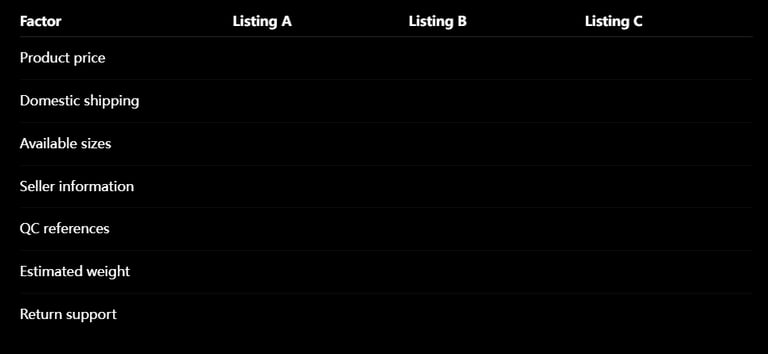
Create a simple comparison based on:
The goal is not automatically to choose the lowest price. Choose the listing that provides the best balance of quality evidence, seller reliability, sizing clarity, and total landed cost.
3. Check Whether the Product Link Is Still Current
Marketplace listings can change, disappear, or be reused. Before ordering a GTBUY Spreadsheet find, confirm that:
The product page still opens
The displayed item matches the spreadsheet description
The listed price has not changed substantially
The required size or color remains available
Recent product photos still match the original listing
The seller has not replaced the product with a different version
An old spreadsheet link may still function while pointing to an updated or substituted product. Always evaluate the current marketplace page rather than relying entirely on the spreadsheet title or thumbnail.
4. Understand Product Price Versus Total Cost
The marketplace price is only one part of the final cost.
A GTBUY order can involve:
Product price
Domestic delivery to the GTBUY warehouse
Optional service or handling charges
Additional QC-photo or service requests, where applicable
Packaging services
International shipping
Insurance
Duties, taxes, or customs charges
GTBUY product pages distinguish between seller-to-warehouse delivery and the later international shipment from the GTBUY warehouse to the buyer’s address. They also indicate that warehouse QC images become available after the item arrives.
A low-priced item may become poor value when it is:
Heavy
Bulky
Fragile
Shipped in oversized retail packaging
Restricted to expensive delivery lines
Likely to require a return or exchange
Before buying, ask:
Would I still consider this a good find after adding domestic delivery and estimated international shipping?
That question eliminates many false bargains.
5. Review the Size Chart, Not Just the Size Label
International buyers should not assume that an Asian-market medium, large, or extra-large matches the same label in their country.
For clothing, focus on actual measurements:
Chest width
Shoulder width
Sleeve length
Total length
Waist
Hip
Inseam
Leg opening
Compare these measurements with a similar item that already fits you.
For footwear, check:
Insole length
EU, UK, US, and CN size conversion
Seller-specific sizing advice
Whether the design runs narrow or wide
Whether half sizes are available
When the listing does not provide useful measurements, ask whether the agent can confirm the size information or provide a measurement photo after warehouse arrival.
A desirable product in the wrong size is not a good find.
6. Use QC Photos as a Decision Tool
QC photos are one of the most useful parts of the shopping-agent process. They show the actual item received at the warehouse rather than only the seller’s promotional images.
GTBUY’s product workflow states that buyers can view quality-inspection photos after an item reaches the warehouse.
When reviewing QC photos, inspect the item systematically rather than looking only at the overall appearance.
Clothing QC checklist
Check:
Front and back alignment
Stitching consistency
Print placement
Embroidery quality
Collar shape
Sleeve symmetry
Fabric appearance
Visible stains or marks
Tags and size labels
Measurements
Footwear QC checklist
Check:
Left and right shoe symmetry
Toe-box shape
Sole alignment
Heel shape
Stitching
Glue marks
Material texture
Size labels
Insole measurement
Damage to the box, when packaging matters
Bag and accessory QC checklist
Check:
Hardware alignment
Zipper operation
Strap attachment
Edge finishing
Stitching
Interior lining
Shape and symmetry
Measurements
Scratches or dents
Included accessories
QC photos can reveal visible defects, but they cannot fully confirm durability, internal construction, material authenticity, long-term performance, or perfect color accuracy.
7. Do Not Confuse Seller Photos With Warehouse QC Photos
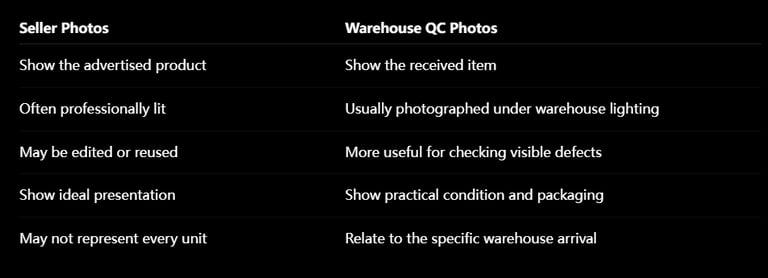
Seller photos are designed to present the product attractively. Warehouse QC photos document the item actually received.
The two serve different purposes:
Use seller photos to understand the intended design. Use QC photos to decide whether the received item is acceptable.
8. Evaluate Seller Reliability Carefully
The phrase “trusted seller” should not be treated as a permanent guarantee.
Seller quality can change over time because of:
Supplier changes
Different production runs
New staff
Listing substitutions
Inconsistent stock
Increased order volume
Different quality levels under one store
Useful seller signals may include:
How long the store has operated
Number and consistency of transactions
Recent buyer feedback
Repeated community purchases
Stable product photography
Clear variation descriptions
Reasonable communication
A history of acceptable warehouse arrivals
Do not rely on a single positive comment or one successful QC example. Look for patterns across multiple purchases and recent evidence.
9. Understand What “Best Batch” Means
The term “batch” is commonly used by online buying communities to distinguish versions or production runs of similar products.
A batch name can help users discuss products, but it is not a formal quality certification.
Even products sold under the same batch name can vary because of:
Production date
Factory changes
Material availability
Seller handling
Storage
Individual manufacturing defects
When comparing batches, consider:
Shape
Materials
Color
Construction
Sizing
Current QC examples
Price difference
Availability
Consistency over time
Do not pay a large premium solely because a listing includes a popular batch label. Confirm that recent product evidence supports the reputation.
10. Look for Recent QC Examples
Recent evidence is more useful than old evidence.
A product with excellent QC photos from many months ago may have changed. Sellers sometimes update factories, materials, patterns, or suppliers without making the change obvious.
Give greater weight to:
Recent warehouse photos
Current buyer feedback
Current sizing information
Recently purchased colorways
Current listing details
Recent seller responsiveness
Older QC examples are still useful for understanding the product, but they should not be treated as a guarantee of current quality.
11. Consider Shipping Weight Before Ordering
International delivery can exceed the cost of the product itself, especially for heavy or bulky items.
Before ordering, consider whether the product includes:
A rigid box
Thick protective packaging
Metal hardware
Large dimensions
Dense materials
Batteries
Liquids
Fragile components
Two products with the same physical weight can have different shipping costs because some lines charge by volumetric weight.
A simplified volumetric-weight formula commonly used in logistics is:
Length × Width × Height ÷ carrier divisor
The applicable divisor and billing method depend on the shipping line.
To reduce costs, users may consider:
Consolidating several warehouse items
Removing unnecessary exterior packaging
Removing shoe boxes when appropriate
Using vacuum packaging for suitable clothing
Comparing available shipping lines
Avoiding oversized low-value items
Do not remove packaging when it is essential for protection, collectability, resale, or structural support.
12. Be More Careful With Electronics
Electronics can appear attractive because of their low marketplace prices, but they involve additional risks.
Check:
Voltage
Plug type
Language options
Wireless compatibility
Battery capacity
Shipping restrictions
Warranty coverage
Replacement-part availability
App-region restrictions
Whether the product is new, refurbished, or used
Warehouse QC may confirm external condition and basic contents, but it may not provide a complete technical test.
For beginners, simple non-powered accessories are usually easier to evaluate than batteries, chargers, audio equipment, smart devices, or complex electronics.
13. Watch for Common Red Flags
Avoid or investigate a listing further when you notice:
Extremely low pricing
A price far below comparable listings may indicate:
Lower-grade material
Incomplete product
A deposit rather than full payment
A different variation
Used or defective stock
Misleading images
No meaningful size information
Missing measurements increase the risk of incorrect sizing.
Inconsistent images
Different backgrounds, designs, labels, or materials may indicate reused photos or mixed product versions.
Vague variation names
Options such as “premium,” “top,” “upgrade,” or “special” are not useful unless the seller explains the differences.
No recent evidence
Old reviews and old QC photos may no longer represent the current item.
Unusually heavy or bulky packaging
This may make an inexpensive item uneconomical to ship.
Pressure to accept defects
A minor cosmetic issue may be acceptable, but the buyer should decide based on the price, intended use, and return options.
14. Know When to Request Additional Photos
Standard warehouse photos may not show every important detail.
Consider requesting additional images when you need to verify:
Clothing measurements
Insole length
A logo or print area
Stitching close-ups
Hardware
Serial or model information
Damage
Included accessories
Color under different lighting
Electronic ports or labels
An inexpensive additional photo may prevent a costly international return problem.
15. Make the Return Decision Before International Shipping
Once an item has been shipped internationally, returning it is usually more complicated and expensive.
Review the product while it is still at the warehouse.
Consider a return or exchange when:
The seller sent the wrong size
The color is incorrect
The product differs materially from the listing
There is visible damage
Important parts are missing
Measurements are far from the stated dimensions
The defect affects normal use
Consider accepting the item when:
The issue is minor
The product remains functional
The price was low
Replacement would cause excessive delay
The return window is limited
The defect is within reasonable manufacturing variation
Always check the current seller and platform return conditions before assuming that a return will be accepted.
16. Use a Total-Value Scoring Method
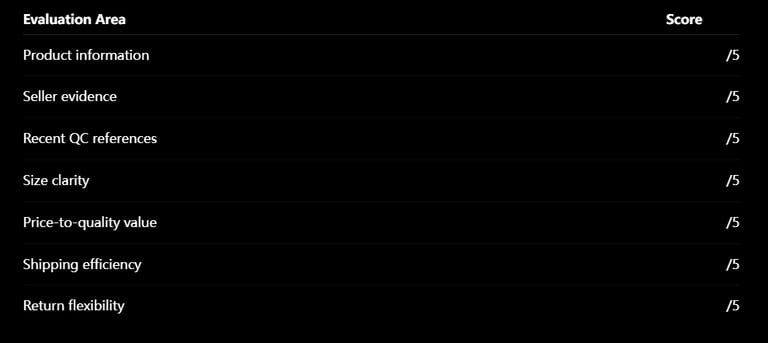
To compare GTBUY Spreadsheet finds more consistently, score each product from one to five in these categories:
A product scoring well across all areas is generally a better find than one that is exceptionally cheap but weak in every other category.
This approach reduces impulse purchases.
Best GTBUY Spreadsheet Categories to Explore
Sneakers
Sneakers are popular because users can compare shapes, materials, sizing and warehouse photos. They also require careful size checking and can be expensive to ship with boxes.
Best for buyers who are willing to compare recent QC images and understand batch variation.
T-Shirts and Tops
T-shirts are usually simple to inspect and relatively efficient to ship. Focus on measurements, fabric weight, print positioning and shrinkage risk.
They are among the more beginner-friendly spreadsheet categories.
Hoodies and Sweatshirts
Hoodies can offer strong value, but their weight increases shipping costs. Check fabric thickness, hood shape, measurements, print quality and overall weight.
Jackets
Jackets require more attention to sizing and construction. Check zipper alignment, lining, sleeve length, insulation and material descriptions.
Pants and Shorts
Waist labels are often insufficient. Always review waist, hip, inseam, rise and leg-opening measurements.
Bags
Check hardware, edge finishing, straps, interior construction and dimensions. Bags with rigid packaging may incur higher volumetric shipping costs.
Hats and Caps
Hats are relatively inexpensive but can lose shape during shipping. Confirm circumference, structure and packaging options.
Accessories
Small accessories can be economical additions to a consolidated parcel, but material claims and exact dimensions should be reviewed carefully.
Electronics
Electronics offer variety but have greater compatibility, warranty and shipping risks. Research the exact model before ordering.
Other Finds
The “Other Finds” category may contain useful home, lifestyle or novelty products. Evaluate each item independently because quality and shipping efficiency vary widely.
GTBUY Spreadsheet Finds: Final Pre-Purchase Checklist
Before submitting an order, confirm:
The marketplace link still opens
The item matches the spreadsheet description
The correct variation is selected
Measurements have been checked
Comparable listings were reviewed
The seller has recent supporting evidence
Domestic shipping is understood
Expected warehouse weight is reasonable
International shipping restrictions were considered
Return conditions were reviewed
You are prepared to inspect warehouse QC photos
The total cost still represents good value
Frequently Asked Questions
What is the GTBUY Spreadsheet?
The GTBUY Spreadsheet is a curated product-discovery resource that organizes marketplace listings into accessible categories. Users can locate products and then use a shopping agent such as GTBUY to purchase from Chinese marketplaces, inspect items at a warehouse and arrange international delivery.
Are all GTBUY Spreadsheet products verified?
A spreadsheet listing should not be interpreted as a permanent quality guarantee. Links, prices, sellers and product versions can change. Buyers should open the current listing, compare recent evidence, review QC photos and confirm details before shipping.
How do I find the best products on the GTBUY Spreadsheet?
Start with a category, compare several similar listings, check measurements, examine recent QC references, assess the seller and estimate total shipping cost. The best find is the product offering the strongest overall value rather than simply the lowest marketplace price.
What are GTBUY QC photos?
QC photos are warehouse images of the item received from the seller. They help buyers inspect visible condition, measurements, color, construction and possible defects before arranging international shipment.
Can QC photos guarantee product quality?
No. QC photos can reveal visible characteristics and defects, but they cannot fully confirm durability, internal construction, material authenticity, electronic performance or long-term reliability.
Should I choose the cheapest listing?
Not automatically. Very cheap listings may involve weaker materials, unclear variations, inconsistent sizing or poor seller support. Compare the product price with available evidence, return conditions and estimated delivery costs.
How can I reduce GTBUY shipping costs?
Consolidate suitable items, compare shipping lines, remove unnecessary packaging where safe, consider volumetric weight and avoid bulky low-value products. Shipping prices and available services vary by destination and parcel characteristics.
Are GTBUY Spreadsheet links from Weidian, Taobao and 1688?
The spreadsheet may include products from major Chinese marketplaces such as Weidian, Taobao and 1688. Availability depends on the current listing and seller.
What should I do when a spreadsheet link no longer works?
Search using the product title or image, check the seller’s current store, look for an updated spreadsheet entry or compare similar listings. Do not order from an unrelated replacement page simply because the old URL redirects.
Is a popular batch name a guarantee of quality?
No. A batch name is a community reference rather than an independent certification. Quality can vary between production runs and individual units, so recent QC evidence remains important.
Final Thoughts
The best GTBUY Spreadsheet finds are products selected through careful comparison rather than impulse. A useful spreadsheet can make product discovery faster, but it cannot replace buyer judgment.
Use the GTBUY Spreadsheet to locate promising products, then evaluate each listing based on current information, recent QC evidence, measurements, seller reliability, total cost and shipping practicality.
A disciplined buying process is simple:
Discover → Compare → Order → Inspect → Consolidate → Ship
Following these steps can help you avoid poor-value purchases and make more informed decisions when sourcing products from Chinese marketplaces.
Recommended Links